
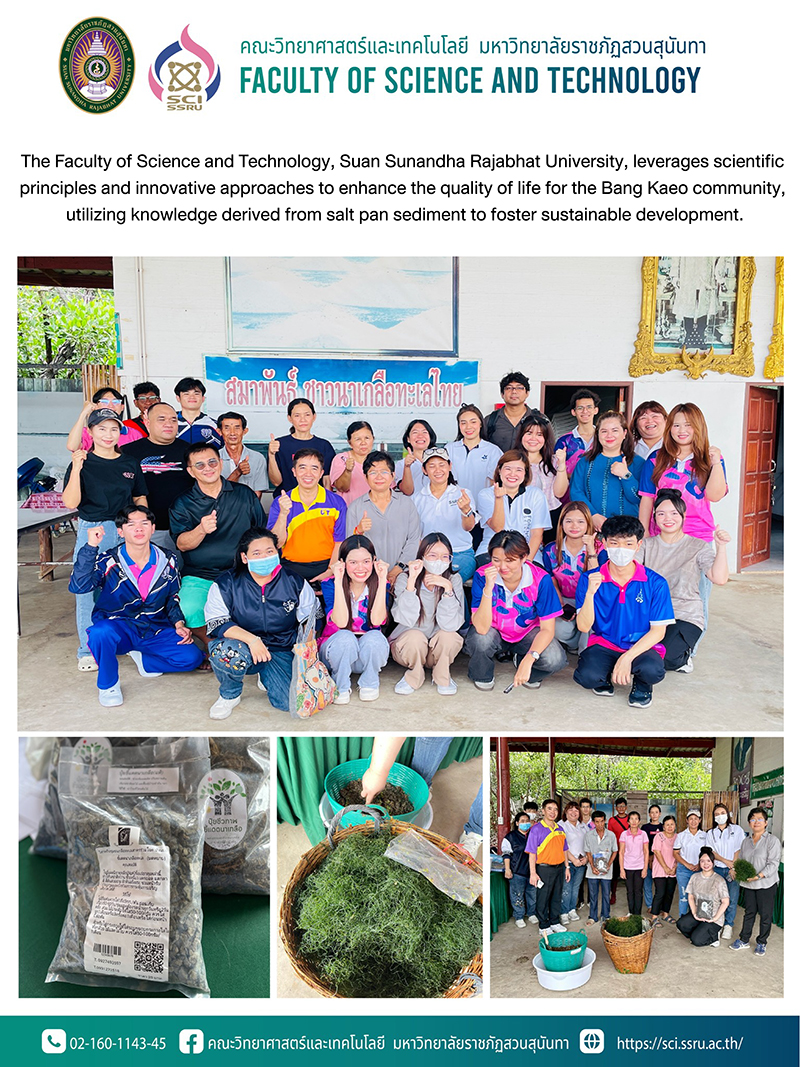
The Faculty of Science and Technology, Suan Sunandha Rajabhat University, leverages scientific principles and innovative approaches to enhance the quality of life for the Bang Kaeo community, utilizing knowledge derived from salt pan sediment to foster sustainable development.
On May 13, 2025, the Faculty of Science and Technology, Suan Sunandha Rajabhat University, led by Assistant Professor Dr. Jittrlada Chumi, Head of the Project, along with faculty members, staff, and students from the Science and Innovation program, conducted a workshop in Bang Kaeo Subdistrict, Mueang District, Samut Songkhram Province. The workshop, titled "Production of Bio-fertilizer from Salt Pan Sediment," was held under the project "Enhancing Quality of Life and Increasing Income for Grassroots Communities through Science, Technology, and Innovation for the Fiscal Year 2025." This activity aimed to tangibly transfer scientific and innovative knowledge to elevate the community's potential for generating income from local resources.
Salt pan sediment, a byproduct of salt farming in Samut Songkhram Province, has been researched and analyzed and found to possess suitable properties for use as bio-fertilizer. It contains essential nutrients such as phosphorus (P) and potassium (K), which are crucial for plant growth. Furthermore, it exhibits excellent water retention capabilities, making it ideal for improving soil structure and efficiently supplementing natural nutrients. Therefore, the team organized a workshop for salt farmers in the Bang Kaeo area, focusing on demonstrating methods for formulating bio-fertilizer from salt pan sediment combined with animal manure. The workshop also provided knowledge on its practical application in cultivation. This initiative aims to create opportunities for supplementary occupations, add value to local waste materials, and sustainably increase household income.
This initiative clearly aligns with the United Nations Sustainable Development Goals (SDGs), particularly SDG 1: No Poverty. This alignment is demonstrated by empowering grassroots communities with skills and knowledge to generate income from local resources, reduce agricultural production costs, and lessen long-term reliance on external factors. Furthermore, it corresponds with SDG 12: Responsible Consumption and Production, by promoting the optimal utilization of waste resources, fostering environmentally friendly production, and advancing a circular economy model that minimizes waste and enhances the efficiency of community-level production systems.
The activity also highlights the crucial role of higher education institutions as catalysts for sustainable local development. This is achieved by genuinely transferring scientific, technological, and innovative knowledge to communities, thereby developing the grassroots economy, enhancing sustainable production capabilities, and improving the quality of life for citizens in accordance with sustainable development principles.