
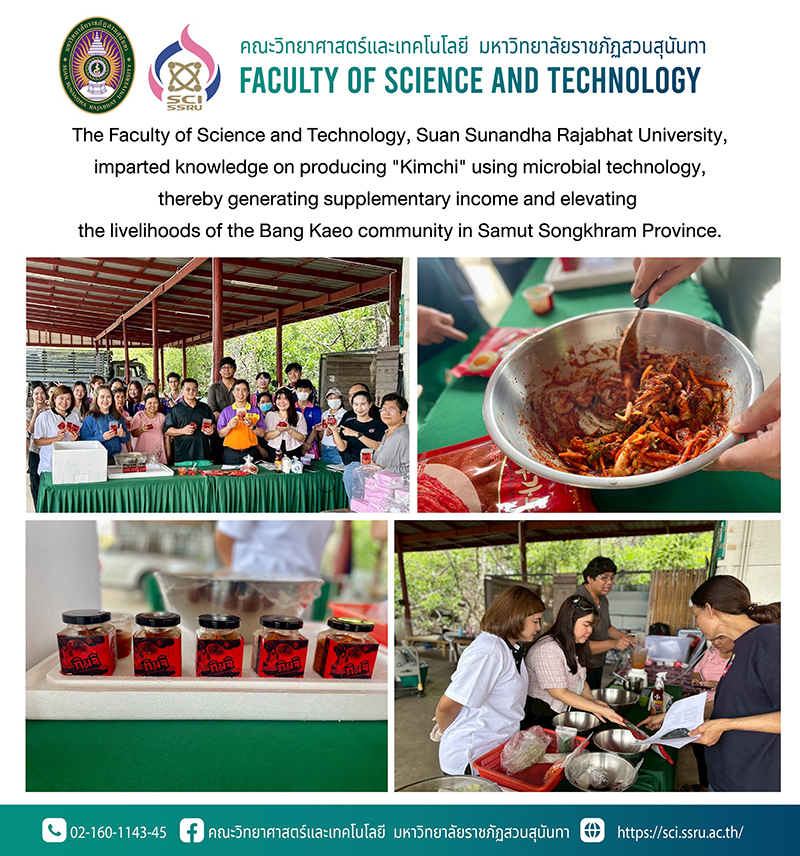
The Faculty of Science and Technology, Suan Sunandha Rajabhat University, imparted knowledge on producing "Kimchi" using microbial technology, thereby generating supplementary income and elevating the livelihoods of the Bang Kaeo community in Samut Songkhram Province.
On May 13, 2025, the Faculty of Science and Technology, Suan Sunandha Rajabhat University, led by Project Head, Lecturer Natthapol Prateungjit, along with faculty members, staff, and students from the Forensic Science program, conducted a practical training workshop in Bang Kaeo Subdistrict, Mueang District, Samut Songkhram Province. The event was part of the "Quality of Life Development and Income Enhancement for Grassroots Communities through Science, Technology, and Innovation" project for the 2025 fiscal year. The primary objective was to impart practical knowledge applicable to daily life, thereby empowering local residents to generate supplementary income and improve their livelihoods.
The workshop focused on teaching the production of napa cabbage kimchi, emphasizing the application of microbial technology through the addition of a Lactobacillus (LAB starter) culture. This beneficial microbial group accelerates the fermentation process and mitigates contamination risks from undesirable microorganisms prior to primary fermentation. This not only elevates the safety and quality standards of the kimchi product but also provides salt farmers in the Bang Kaeo area with an avenue to develop supplementary careers. By utilizing readily accessible ingredients and adapting the process to suit the local community's way of life, the faculty delivered detailed lectures on recipes, ingredients, and production steps, complemented by practical demonstrations to ensure participants could independently perform the process.
The aforementioned activities demonstrably align with the United Nations' Sustainable Development Goals (SDGs), particularly Goal 1: No Poverty. This alignment is achieved through the creation of economic opportunities for grassroots populations by imparting knowledge on sustainable supplementary occupations, leveraging available local resources. Furthermore, the initiatives reflect Goal 9: Industry, Innovation, and Infrastructure by promoting accessible community-level innovation, specifically through the application of microbial technology in food production to enhance quality and safety. Finally, they contribute to Goal 12: Responsible Consumption and Production by encouraging communities to systematically produce safe food from natural ingredients, ensuring consumer safety.
This project, therefore, not only facilitates the transfer of scientific and technological knowledge to communities but also serves as a model for integrating the role of higher education institutions in sustainably improving the quality of life for local populations across economic, social, and health dimensions.