
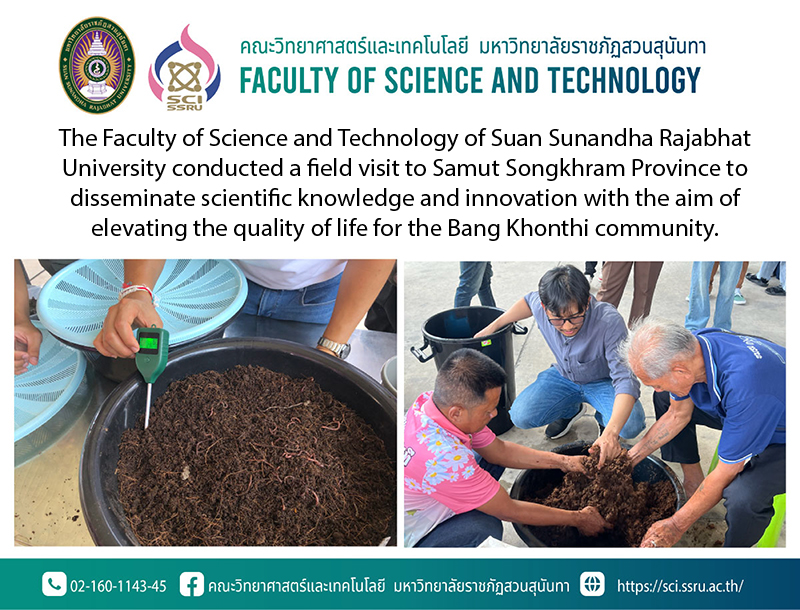
The Faculty of Science and Technology of Suan Sunandha Rajabhat University conducted a field visit to Samut Songkhram Province to disseminate scientific knowledge and innovation with the aim of elevating the quality of life for the Bang Khonthi community.
On April 30, 2025, the Faculty of Science and Technology, Suan Sunandha Rajabhat University, led by Associate Professor Dr. Sumitra Nuanmeesri, along with faculty members, Information Technology students, and social innovation students, conducted a field activity under the project "Development of Quality of Life and Income Enhancement for Grassroots Communities through Science, Technology, and Innovation" at the Bang Khonthi Subdistrict Administrative Organization, Bang Khonthi District, Samut Songkhram Province. The initiative aimed to enhance knowledge and increase vocational opportunities for individuals at the grassroots level through the transfer of technology applicable to daily life.
The primary activity involved a practical workshop on "Earthworm Farming with Digital Equipment Application," which garnered significant interest from local residents. The training curriculum focused on providing participants with knowledge ranging from the fundamental steps of earthworm cultivation and production system management to the utilization of digital innovations and equipment for process control and monitoring. This aimed to enable the production of high-quality vermicompost for agricultural use in soil restoration, enhancement of essential plant nutrients, and reduction of reliance on chemical fertilizers. Furthermore, it contributes to the long-term environmental benefit of mitigating the toxicity of certain soil minerals such as aluminum and manganese.
The event was honored by the presence of Ms. Renu Leknimit, President of the Bang Khonthi Subdistrict Administrative Organization, who presided over the opening ceremony and extended a welcome to the resource persons. The activity also benefited from the collaboration of Mr. Chotiwat Srisuwan and Dr. Lap Pumhiran, who provided insightful lectures and detailed demonstrations on earthworm farming techniques. This fostered a warm and engaging participatory learning environment between the university and the community.
This project represents a significant step towards driving the concept of sustainable development, aligning with several Sustainable Development Goals (SDGs) of the United Nations. These include poverty eradication through the creation of low-cost yet high-yield vocational opportunities (SDG1), promotion of food security via natural fertilizer production that enhances agricultural yields (SDG2), provision of lifelong learning opportunities for both community members and students through practical engagement (SDG4), and fostering community-level economic growth based on sustainable self-reliance (SDG8). Additionally, the project supports the efficient management of local resources (SDG11) and environmentally friendly production practices, which are central to strengthening urban and community resilience (SDG12) and ensuring balanced adaptation to future changes.