
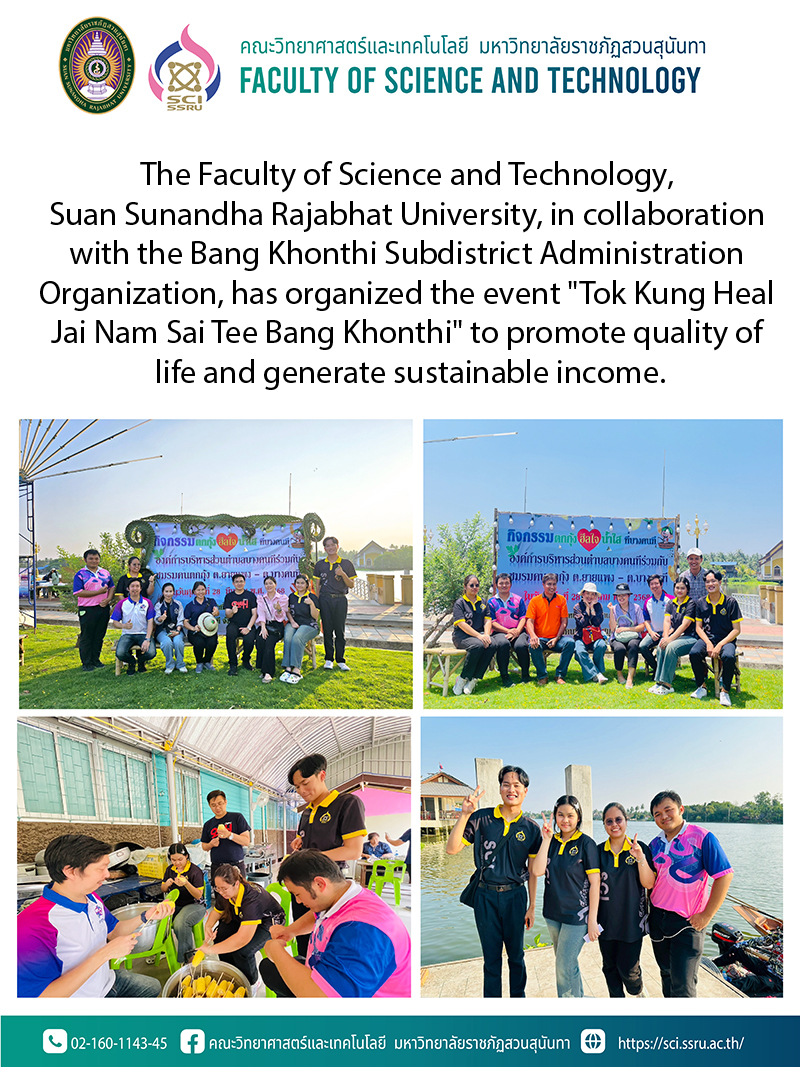
The Faculty of Science and Technology, Suan Sunandha Rajabhat University, in collaboration with the Bang Khonthi Subdistrict Administration Organization, has organized the event "Tok Kung Heal Jai Nam Sai Tee Bang Khonthi" to promote quality of life and generate sustainable income.
On March 28, 2025, the Faculty of Science and Technology, Suan Sunandha Rajabhat University, collaborated with the Bang Khonthi Subdistrict Administrative Organization, Samut Songkhram Province, to organize the activity "Tok Kung Heal Jai Nam Sai Tee Bang Khonthi" at the Bang Khonthi District Office. This initiative was conducted under the project for "Developing the Quality of Life and Raising the Income of Grassroots Communities through Science, Technology, and Innovation, Fiscal Year 2025." The activity aimed to foster cooperation among the academic sector, the public, and local agencies in promoting career creation, income generation, and the improvement of environmental quality within the community.
The event was led by Associate Professor Dr. Narong Sangvaranatee, head of the Shrimp Catching Club project, along with a team of faculty members including Assistant Professor Dr. Kittikhun Meethongjan, Associate Professor Dr. Nisakorn Sangvaranatee, Lecturer Dr. Jarusporn Passakham, Lecturer Melanie Urasanit, and supporting staff members Ms. Panisara Nituthorn, Head of Research and Academic Services Development, Mr. Pannawat Thongsuk, and Mr. Suppapol Khamchuen. Social innovation students also participated in the field activities alongside members of the Shrimp Catching Club and the Bang Khonthi community. Water samples were collected from canals and the Mae Klong River in the Yay Paeng and Bang Khonthi subdistricts for water quality analysis. The analysis results will be reported back to the community in due course, enabling residents to utilize scientific data for efficient and sustainable water resource management.
Furthermore, the event was honored by the presence of Ms. Renu Leknimit, Mayor of the Bang Khonthi Subdistrict Administrative Organization, who provided an interview regarding the concept behind the "Tok Kung Heal Jai Nam Sai Tee Bang Khonthi" activity. She emphasized the importance of promoting enjoyable and relaxing community activities that simultaneously create new career opportunities for local people, particularly shrimp catching for consumption and sale, which holds potential as a supplementary occupation in terms of both economics and eco-tourism.
This activity aligns with the Sustainable Development Goals (SDGs), specifically Goal 3: Good Health and Well-being, as shrimp catching is an outdoor activity that promotes physical and mental health, fosters relaxation, and reduces stress for participants. It also supports Goal 6: Clean Water and Sanitation, through water sampling and quality analysis, which helps raise community awareness about the importance of clean water sources and the sustainable conservation of local water resources.
Moreover, the activity connects with Goal 8: Decent Work and Economic Growth, by creating opportunities for local residents to earn supplementary income from shrimp catching, with plans to expand into eco-tourism activities in the future. It is also consistent with Goal 17: Partnerships for the Goals, demonstrating strong collaboration between educational institutions, government agencies, and local communities, which is a fundamental basis for driving the development of strong and sustainable grassroots communities.
This project is therefore another initiative where the Faculty of Science and Technology applies its academic knowledge to real-world contexts, facilitating participatory development based on the knowledge, understanding, and potential of the community.