
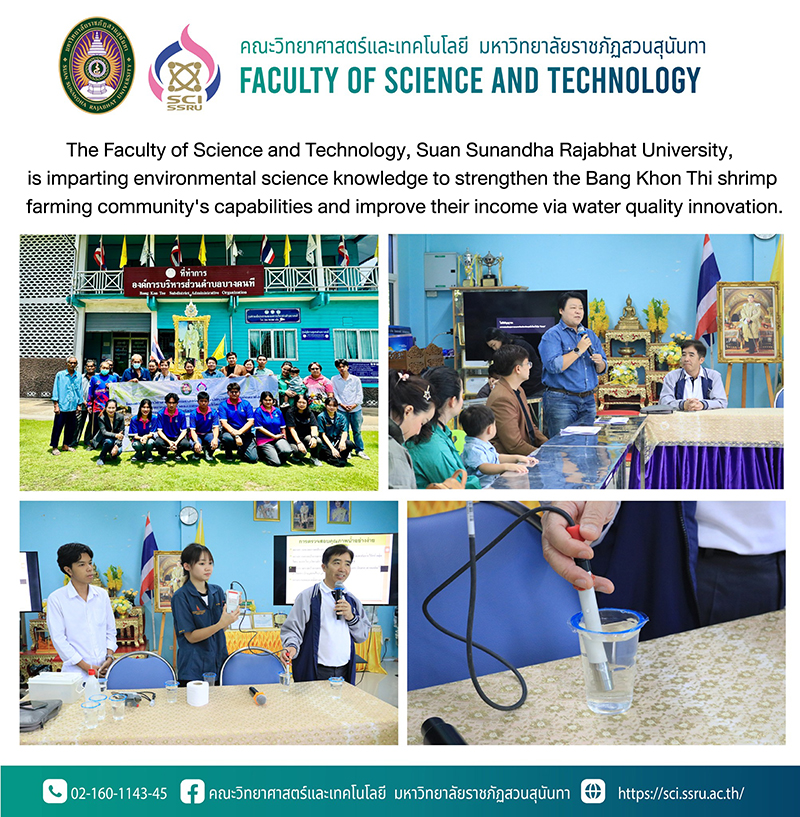
The Faculty of Science and Technology, Suan Sunandha Rajabhat University, is imparting environmental science knowledge to strengthen the Bang Khon Thi shrimp farming community's capabilities and improve their income via water quality innovation.
On June 4, 2025, the Faculty of Science and Technology at Suan Sunandha Rajabhat University, led by Associate Professor Dr. Narong Sangwaranatee, Head of Project, along with group members, staff, and social engineer students, conducted a workshop at the Bang Khonthi Sub-district Administrative Organization in Bang Khonthi District, Samut Songkhram Province. This activity was held under the project "Improving Quality of Life and Increasing Income for Grassroots Communities through Science, Technology, and Innovation." Assistant Professor Dr. Sopit Sawangjit, Deputy Dean for Research and Academic Administration, reported on the significance of the event. The opening ceremony was presided over by Ms. Renu Leknimitr, Chief Executive of the Bang Khonthi Sub-district Administrative Organization, who also delivered a welcoming address to the project team.
The main activity was a workshop on water quality for shrimp farming, conducted in collaboration with Associate Professor Dr. Chaisri Tarasawatpipat. Dr. Tarasawatpipat served as the instructor, imparting knowledge and demonstrating detailed procedures for water quality measurement. The workshop covered various topics, including: Simple water quality testing, Minerals essential for shrimp osmoregulation, Beneficial minerals for shrimp, Appropriate assessment of water quality, shrimp tissue, and soil sediment.
The objective of this workshop was to enhance the knowledge and applied scientific skills of shrimp farmers and local residents, enabling them to more effectively manage aquatic animal production systems.
This project directly aligns with several Sustainable Development Goals (SDGs). It addresses SDG 1: No Poverty by striving to create career opportunities and increase income for grassroots communities, primarily through the application of science and technology. Furthermore, it is consistent with SDG 8: Decent Work and Economic Growth, as its activities are designed to empower farmers and communities to engage in sustainable economic activities and enhance productivity. The project also contributes to SDG 14: Life Below Water, underscored by its emphasis on fostering awareness and knowledge regarding water quality management—a vital resource for coastal ecosystems and livelihoods. Additionally, it fulfills SDG 17: Partnerships for the Goals, demonstrating concrete collaboration among universities, local government organizations, civil society, and academic sectors in exchanging knowledge and collectively driving development.
The training activities were conducted in a welcoming atmosphere, fostering mutual learning among instructors, participants, and students. A key focus was placed on promoting participation and establishing academic networks with communities to achieve tangible and sustainable improvements in quality of life.